
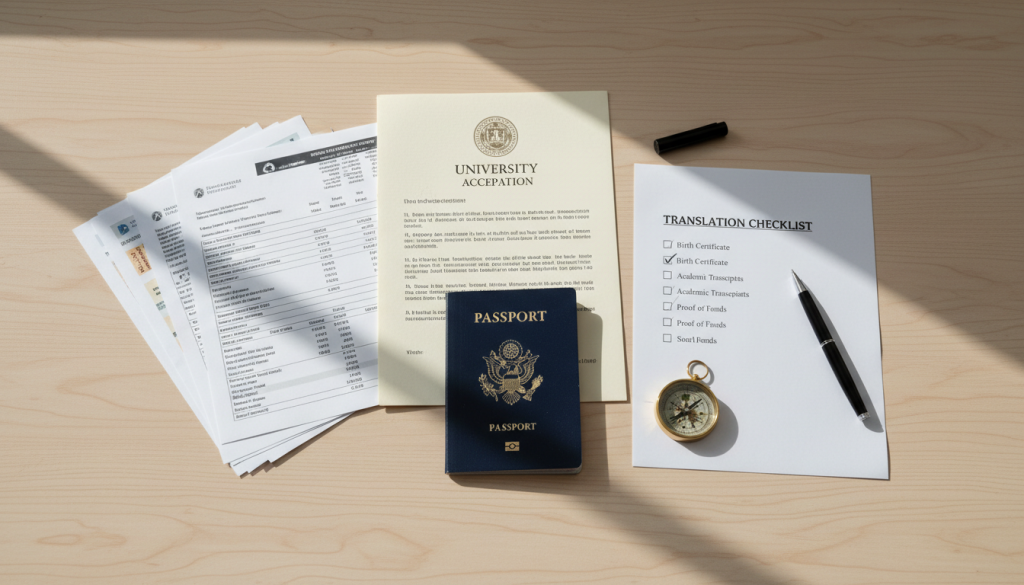
Applying for a student visa can quickly become expensive and stressful, especially when your paperwork is in multiple languages. A clear student visa translation checklist is essential to avoid two common pitfalls: paying for unnecessary translations and missing certified translations for crucial documents that support your application.
The simplest rule is this: if a document is not in English or Welsh and is required for your application, it should typically be translated in full and certified. The real challenge lies in knowing which documents need to be included in your submission.
If you want your submission to proceed smoothly, focus on evidence rather than translating everything you own.
The short answer
- Translate:
- Any non-English or non-Welsh document you are submitting as evidence
- Any academic or financial document specifically tied to your offer, CAS, or eligibility
- Any under-18 or sponsor-related document you are relying on
- Do not rush to translate:
- Documents you are not submitting
- Documents already issued in English or Welsh
- Duplicate copies of the same evidence
- Background paperwork that has not been requested
- The CAS itself
A student visa file is most effective when every translated document serves a clear purpose.
The student visa translation checklist
Translate now:
- Bank statements in another language
- CAS details
- Student loan letters
- Reference letters
- Scholarship or sponsor letters
- Birth certificate for under-18 applicants
- Previous academic documents for degree-level cases
- ATAS certificate
- Parental consent documents
- Certificates, transcripts, or result printouts you must submit
- Fee receipts if not already confirmed on the CAS
Check first:
- Academic certificates not clearly required in your evidence pack
- English-language university letters
- Approved English test results already in English
- UK bank statements already in English
Usually skip:
- Prior immigration documents not directly relevant
- Duplicate scans and background papers
Start with the evidence list, not the document pile
Many applicants mistakenly believe that translating everything is the safest approach. However, student visa files are more effective when they are selective. Each document should support one of five key purposes:
- Identity
- Academic eligibility
- Financial evidence
- Age or family-related requirements
- Route-specific conditions such as ATAS or TB testing
If a document does not help prove one of these points, it is likely not contributing to your application. Instead, it adds unnecessary costs and increases the risk of inconsistencies in names, dates, numbers, and document history. Therefore, it is wise to review the actual evidence requirements first and only order translations for the documents you genuinely need.
Academic documents: when to translate certificates and transcripts
Academic paperwork is a common area where students overspend on translations.
If your offer or CAS relies on qualifications
Translate the certificate, transcript, or official result printout used to obtain the offer if those documents are part of the evidence you need to provide. Pay close attention to:
- Your name
- Award title
- Institution name
- Completion or award date
- Any stamp, seal, handwritten note, or result annotation
A mismatch between the original document, the translation, the application form, and the CAS can lead to unnecessary questions.
If the sponsor assessed you through references
Sometimes the key evidence is not a diploma. If your university relied on references, translate only the reference or references you are submitting rather than translating every old school or university document you possess.
If the sponsor assessed you through an interview, portfolio, or internal test
Do not assume that all foreign academic paperwork must be translated for a student visa application. If your sponsor assessed you in another way and the old certificates are not part of your submission, they may not require translation.
Degree-level applicants: the biggest area of wasted spend
Many degree-level applicants automatically translate prior academic records without checking if those documents are even needed in their evidence pack. In practice, the file often hinges on the CAS, financial evidence, and route-specific requirements rather than a lengthy archive of earlier qualifications. A careful pre-check can save both money and time. If you are unsure, consider having your file reviewed before ordering any translations.
Financial evidence: what to translate and what to leave alone
Financial evidence is often the most critical translation priority in a student visa file. Translate any non-English financial document you are using to prove funds, such as:
- Personal bank statements
- Parent’s bank statements
- Partner’s bank statements, where permitted
- Student loan letters
- Official sponsorship or scholarship letters
- Fee payment receipts where they matter to the application
- Financial sponsor approval letters where required
Avoid translating extra bank statements from unused accounts simply because they exist. A single clear financial route is preferable to multiple overlapping documents that may cause confusion.
What to check before ordering a bank statement translation
Before you pay for translation, ensure the original statement is worth translating. Check that it includes:
- The account holder’s name clearly
- The bank’s name clearly
- Readable dates
- Readable balances
- The required funds for the relevant holding period
- A recent enough issue date for your application
If the statement is unclear, cropped, or incomplete, fix the source file first. A polished translation cannot compensate for an unreadable original.
Under-18 applicants: translate more carefully, not more widely
If you are under 18, your file may require more family-related evidence than an adult student application. This can include translating:
- Parental consent
- Birth certificate or equivalent official record
- Any guardian or care-related document you are submitting
However, it does not mean you should translate every family document you possess. The goal is to provide clear evidence of the required consent and relationship, not to compile a family archive.
Documents that are often already usable without translation
Some documents are commonly issued in English or are typically used in a form that does not require translation. These often include:
- CAS details
- ATAS certificate
- English-language university letters
- English-language bank documents
- Approved English test evidence already issued in English
- TB certificates already issued in English by approved clinics
The key question is not, “Is this an official document?” but rather, “Am I submitting this, and is it already in English or Welsh?”
What a certified translation should include
A student visa translation is not merely a language conversion; it must be prepared correctly for official use. A complete certified translation should include:
- Confirmation that it is an accurate translation
- The date of translation
- The full name and signature of the translator or an authorized representative
- The contact details of the translator or translation company
For student files, layout is also important. A well-prepared translation should make names, dates, tables, stamps, notes, and marginal details easy to compare against the original. This is especially crucial when facing university enrollment or visa deadlines.
A practical way to pack your file before upload
Follow this order before submitting anything:
- Core identity documents: Passport, travel document, application record, and CAS details.
- Academic evidence: Only the certificates, transcripts, references, or result printouts you need for this application.
- Financial evidence: One clear funding route supported by translated documents where necessary.
- Conditional evidence: ATAS, TB certificate, parental consent, financial sponsor approval, or any other route-specific paperwork.
- Translation set: For every non-English or non-Welsh document you are relying on, keep the original and the matching certified translation together.
This simple structure makes it easier to spot missing translations before a deadline.
Three common student visa scenarios
Master’s applicant with a UK university offer
You have your CAS, your university has already assessed your English, and your bank statements are in another language. In this case, the urgent translation work usually focuses on the financial evidence, not every old certificate from previous studies.
17-year-old applicant
Your file may include non-English parental consent, a birth certificate, and family-linked financial evidence. Here, relationship and consent documents should be prioritized.
Sponsored postgraduate in a sensitive subject
Your sponsor letter may need translation if it is not fully recorded in English and you are relying on it. Typically, your ATAS certificate is already usable as issued, so the budget often belongs elsewhere.
How translation problems delay student visa files
Most delays do not stem from language alone; they arise from avoidable presentation issues.
Name mismatch
A passport spelling, bank statement spelling, and translation spelling must align. Even small variations can raise questions.
Date confusion
Mixed date formats and unclear award or statement dates complicate file reviews.
Missing stamp or note translation
A caseworker may value a handwritten note or rubber stamp as much as the main body text.
Poor scan quality
If the original scan is blurry, cropped, shadowed, or cut off, the translation process begins on shaky ground.
Over-submission
Extra paperwork creates more opportunities for contradictions. A focused file is generally easier to review than a bloated one.
What to prioritise when time is tight
Student deadlines often converge. CAS release, tuition payment, funding evidence, enrollment windows, and travel dates can all occur simultaneously. If you need to act quickly, prioritize in this order:
- Non-English financial evidence
- Non-English academic evidence that is directly required
- Under-18 consent or relationship documents
- Any non-English supporting document you know you will upload
This approach safeguards the application first and the budget second. At this stage, speed without document control is risky. It is better to translate the right four documents urgently than the wrong twelve documents by tomorrow.
A better way to order student visa translations
The safest workflow is straightforward:
- Gather the documents you genuinely plan to submit.
- Separate English/Welsh documents from non-English ones.
- Identify which documents prove funding, academic eligibility, or route-specific conditions.
- Translate only the non-English documents that are actually doing that work.
- Check the translated set against the application before upload.
To maintain efficiency, send your student visa file as one batch rather than one document at a time. This makes it easier to identify duplicate evidence, missing pages, and unnecessary translation costs before the work begins.
At Next Day Translation, we handle student files with meticulous attention to names, dates, tables, stamps, references, and official formatting. We offer same-day and next-day options for urgent academic and immigration submissions, which is particularly beneficial when enrollment or visa timelines compress unexpectedly.
One recent academic client needed foreign degree documents turned around before university enrollment and received a same-day certified pack that was accepted immediately. Another time-sensitive immigration client required a fully prepared file within hours and received it quickly enough to keep the application moving.
If your student visa deadline is approaching, upload the documents you plan to use and get the file checked in one pass. This is the fastest way to determine what needs certified translation, what can remain unchanged, and what should not be included in the pack at all.
FAQs
Do I need to translate bank statements for a student visa?
Yes, if you are using bank statements as financial evidence and they are not in English or Welsh, they should be translated in full and certified. If the statements are already in English, you typically would not need a translation.
Do I need to translate my degree certificate for a UK student visa?
Only if that certificate is part of the evidence you need to submit and it is not in English or Welsh. Many applicants mistakenly assume every academic document must be translated; the better question is whether the document is actually needed in the application.
What should a certified translation include for a student visa?
A certified translation should include a statement confirming accuracy, the date of translation, the full name and signature of the translator or authorized representative, and the translator’s or translation company’s contact details.
Do I need to translate my passport for a student visa?
Usually not, provided your passport or travel document is already usable in its issued form. What matters is whether the document is submitted in a language that requires translation and whether the receiving authority needs an English or Welsh version.
Can I use an English version issued by my university instead of a certified translation?
In many cases, yes, if the university has issued an official English-language version of the document and that version is accepted for your purpose. If there is any doubt, check before submitting rather than assuming the document will be treated the same as a certified translation.
What if only part of the document is in another language?
Do not assume a partial translation is sufficient. If the document is relied upon in the application, the safest approach is usually a full certified translation to ensure that headings, stamps, side notes, and handwritten entries are not overlooked.