
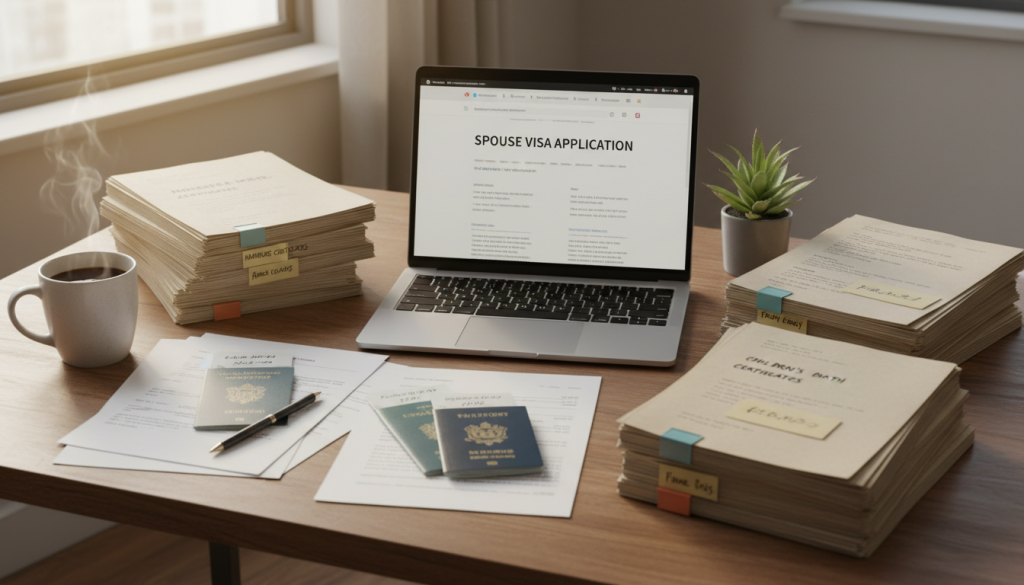
Applying for a spouse visa often feels straightforward at the start. Most couples remember the obvious document, usually the marriage certificate, and assume that is the main translation task. The trouble starts when the supporting evidence pack is built around it. Financial records, address evidence, previous civil status documents, children’s records, and foreign-language proof of relationship are often added late, and that is where avoidable delays begin.
A strong spouse visa file is not just about translating the headline certificate. It is about translating every non-English or non-Welsh document you actually rely on, presenting it clearly, and making sure the whole pack reads consistently from first page to last.
If you are close to submission and not fully sure what still needs translating, gather the entire file before ordering anything. That single step prevents most last-minute omissions.
The short checklist most people need
For many spouse visa applications, the forgotten items sit in one of these groups:
- Marriage or civil partnership certificate
- Divorce decree, annulment record, or death certificate from a previous marriage
- Bank statements used for financial evidence
- Payslips and employer letters issued in another language
- Tenancy agreement, housing document, or residence registration
- Utility bills or address proof you rely on to show cohabitation
- Birth certificates for children included in the family story or application
- Family book, household register, or civil registry extract
- Travel evidence and selected message records used to show the relationship is genuine
- Any name-change document that explains why names differ across records
That is the spouse visa translation checklist most applicants wish they had at the beginning, not the night before upload.
Why these files go wrong
The usual pattern is simple. Couples translate the document that feels official and forget the documents that explain it.
A marriage certificate shows that the marriage exists. It does not by itself explain the financial position, the living arrangements, the history of previous relationships, the names appearing across different records, or the practical reality of the relationship. Those details often sit in documents people think of as “supporting,” but they can carry just as much weight when the file is reviewed.
Another common issue is inconsistency. One document spells a surname one way, a bank statement uses a different transliteration, and an older family register shows a third version. None of that is fatal if explained properly, but when the translations are ordered piecemeal from different providers, the pack can end up looking disjointed.
A better approach is to treat the application as one certified pack, even if the documents come from different sources.
Start with the relationship foundation documents
Marriage certificate or civil partnership certificate
This is the document almost everyone remembers, and for good reason. It is the anchor document for the relationship itself. But applicants often forget that the following may also need translation if they are part of the evidence set.
Previous marriage ending documents
If either partner was previously married or in a civil partnership, the file may need documents showing that relationship ended lawfully. Common examples include:
- Divorce decree
- Certificate of dissolution
- Annulment order
- Death certificate of a former spouse
These are frequently overlooked because they feel historical. In practice, they can be essential where earlier relationships affect current marital status.
Family book, household register, or civil status extract
In many countries, a marriage is also reflected in a family register, household book, or civil record extract. Applicants often rely on these to strengthen the file, especially where names, children, or household details are easier to see there than on a single certificate.
These records are easy to forget because they are not always requested by name, but they can become important when the main certificate is brief, damaged, handwritten, or difficult to interpret.
Name-change or identity-bridging documents
If one spouse changed surname after marriage, or if spellings differ across passports, bank statements, birth certificates, and civil records, include the documents that bridge those differences. Typical examples include:
- Name-change certificates
- Official amendments to civil records
- Old and new identity documents
- Registry letters confirming spelling variations
This is one of the most valuable ways to reduce confusion in a spouse visa pack.
The financial evidence people forget to translate
Financial evidence is where many translation gaps appear because couples focus on the numbers, not the language of the document.
Bank statements
Bank statements are one of the most commonly forgotten documents in a spouse visa translation checklist. Applicants often assume the figures are easy to understand without translation. But if account headings, transaction descriptions, account holder names, bank stamps, or explanatory notes appear in another language, the document can be incomplete for submission purposes.
Translate the statements you are actually relying on, not just the most recent page. If a statement runs across multiple pages and those pages form one document, keep the translation complete and consistent.
Payslips
If payslips are being used and they were issued in another language, they are often missed because they look repetitive. Repetition is exactly why they matter. A file that includes six months of income evidence should not suddenly switch from translated to untranslated halfway through the sequence.
Make sure salary labels, deductions, employer name, issue dates, and any notes or stamps are handled clearly.
Employer letters
Employer letters are easy to overlook because they are often requested after the main pack is already underway. If the letter is in another language and supports the financial position, it should be translated with the rest of the income evidence.
This matters especially where the employer letter confirms role, salary, contract type, length of employment, or the authenticity of payslips.
Savings, rental, dividend, or other supporting income documents
Not every spouse visa file relies on employment income alone. Some rely on savings, property income, dividends, or more complex financial structures. In those cases, applicants often remember the main bank evidence but forget the document that explains the source. That may include:
- Savings certificates
- Rental agreements
- Dividend records
- Account confirmation letters
- Ownership records supporting income
The rule of thumb is practical: if the document helps explain how the financial evidence works, do not leave it untranslated.
Shared life and address evidence often gets missed
A spouse visa file is not just about legal status and money. It is also about showing a real shared life.
Tenancy agreements and housing records
If you are relying on a tenancy agreement, residence registration, municipal address record, landlord letter, or mortgage-related housing document in another language, it belongs in the translation plan. These documents are often forgotten because applicants think of them as housing proof rather than visa evidence. If they are part of your file, they are visa evidence.
Utility bills and joint address documents
Bills and address records can be powerful because they help show cohabitation and shared responsibility. The issue is that applicants often submit them in batches and miss one or two documents in another language. Check carefully for:
- Electricity bills
- Water bills
- Gas bills
- Internet bills
- Building management statements
- Local tax or residence-related notices
- Joint account correspondence tied to the same address
Council or local authority letters from abroad
Some couples have foreign address evidence issued by municipalities, local councils, or civil offices outside the UK. These are highly useful when tenancy paperwork is limited, but they are also commonly forgotten at translation stage because they arrive late or look informal. If the letter supports address history, translate it.
Children’s documents are often added too late
Where children are part of the application or relevant to the relationship story, their documents are often gathered near the end. That is exactly why they get missed.
Birth certificates
If a child’s birth certificate is in another language and the application includes the child, mentions the child, or relies on the document to show family life, have it translated with the rest of the pack.
School, medical, or custody-related documents
Not every application needs these, but when they are used, they are often important. Examples include:
- School letters showing family address
- Consent letters
- Court orders
- Guardianship papers
- Medical letters showing parent-child details
These documents can carry sensitive information and should be handled carefully, but they should not be left half-prepared.
Relationship evidence is where couples under-translate
Applicants often assume relationship evidence is informal and therefore does not need the same care as civil records. That assumption causes problems.
Chat logs and message screenshots
You do not usually need to translate months and months of repetitive everyday chat. What helps more is a representative selection showing continuity across time. Choose samples that clearly show:
- Ongoing contact
- Significant dates
- Travel planning
- Family events
- Practical discussions about shared life
If the screenshots are in another language, translate the text you rely on. A short, well-chosen set is usually more persuasive than hundreds of untranslated images.
Travel evidence
Tickets, hotel bookings, itinerary emails, and booking confirmations are often used to show visits and time spent together. If the meaningful text is in another language, translate it. This does not mean translating every code and every airline abbreviation. It means making sure the content that proves the trip is readable and clear.
Photographs with captions or explanatory notes
Photographs themselves do not need translation. Captions, album text, handwritten notes, invitations, and event documents attached to them may. If a photo set only makes sense because of the accompanying text, include the translation of that text.
What a properly prepared certified pack should include
A strong pack does more than convert words from one language into another. It makes the application easier to follow. A well-prepared spouse visa translation pack should aim for:
- Full translation rather than a summary
- Clear handling of stamps, seals, signatures, and handwritten notes
- Consistent spelling of names across all documents
- Clear dates and document titles
- Readable formatting that mirrors the original structure
- One obvious naming system across the whole file
One of the easiest wins is to create a single spelling sheet before ordering. Write down the exact English spelling you want used for each person, place, and institution. Then keep it consistent across the entire pack. That alone can make a file look far more professional.
What usually does not need translating
This is where couples can save money without weakening the application. In many cases, you do not need to pay to translate:
- Documents already in English or Welsh
- Duplicate copies of the same record
- Blank reverse pages with no stamps, notes, or printed text
- Extra background documents you are not actually submitting
- Huge volumes of repetitive chat where a smaller representative sample will do
The important caution is this: do not confuse “not important” with “not obvious.” A page that looks blank may still contain a stamp, registry mark, marginal note, or reference number that matters. When in doubt, review the full file before removing anything from the translation order.
A practical spouse visa translation checklist before you submit
Use this quick pre-submission check:
- Put every document you plan to upload into one folder.
- Highlight every page that contains non-English or non-Welsh text.
- Group the file into identity, relationship, finances, address, children, and extras.
- Check for old marriages, name changes, and children’s records.
- Remove duplicates and irrelevant background material.
- Make sure dates, names, and address history line up across the pack.
- Order the translations as one bundle, not as scattered one-off jobs.
That last step matters more than many people realise. A bundle approach reduces inconsistent terminology, duplicate charges, and last-minute rework.
Common mistakes that make spouse visa files look weaker
Even when couples gather the right documents, the presentation can still create problems. The most common mistakes are:
- Translating only the marriage certificate and leaving the supporting evidence untouched
- Submitting bank statements but forgetting payslips or employer letters in another language
- Missing an old divorce document that explains current marital status
- Using different English spellings of the same name across different translations
- Translating selected pages only, even though the rest of the document is part of the evidence set
- Overloading the file with irrelevant relationship screenshots instead of a clear sample
- Sending poor-quality scans that make stamps, seals, and handwritten notes unreadable
- Leaving address evidence out because it feels “secondary”
A spouse visa file reads best when it tells one simple story: who you are, what the relationship is, where you live, how the finances work, and why the document set is consistent.
If you are ordering urgently
Urgent spouse visa files are very common, especially when couples realise late that non-English evidence still needs to be prepared. To move faster without losing clarity:
- Send the entire evidence pack at once.
- State the submission deadline in the first message.
- List the exact authority or application route.
- Mention any transliteration issues immediately.
- Flag handwritten or stamped pages that must not be missed.
- Ask for digital PDF delivery first if time is tight.
- Request hard copy only if your submission route or adviser needs it.
If you want to avoid a rushed second order, ask for the full spouse visa pack to be checked for missing translations before work begins.
A simpler way to think about the file
The easiest way to build this application is to think in layers. Layer one is the legal relationship: marriage, civil status, previous marriages ending, identity. Layer two is the practical relationship: where you live, what you pay for together, how the relationship has continued over time. Layer three is the financial relationship: income, savings, supporting letters, and the source behind the numbers. Layer four is the explanation layer: name differences, missing records, unusual timelines, and any document that helps the reviewer understand the rest. Most translation omissions happen because couples prepare layer one and forget layers two to four.
Need the pack checked before you submit?
If your spouse visa file includes a marriage certificate, bank statements, proof documents, and address evidence from more than one country, it is usually faster to have the whole bundle reviewed at once rather than guessing document by document. A complete certified pack is easier to price, easier to translate consistently, and easier to submit with confidence. If you are close to deadline, send the full set in one go and ask for a same-day or next-day review of what actually needs translating. That is usually the quickest route to a cleaner submission.
Final thought
The strongest spouse visa files are rarely the biggest. They are the clearest. A good spouse visa translation checklist does not just ask, “Did we translate the marriage certificate?” It asks, “Did we translate every non-English document we are relying on to prove the relationship, the finances, the address history, and the family story?” That is the difference between a file that feels assembled and a file that feels ready.
Frequently asked questions
Do I need to translate bank statements for a spouse visa?
If the bank statements you are submitting are not in English or Welsh, they should be translated as part of your spouse visa evidence pack. Do not focus only on the balances. Account holder details, headings, dates, transaction descriptions, and bank notes can all matter.
Is the marriage certificate enough for a spouse visa translation checklist?
No. The marriage certificate is usually only one part of the file. Many couples also need translations for financial evidence, housing records, previous marriage-ending documents, children’s records, and selected relationship evidence.
Do I need to translate chat screenshots for a spouse visa?
If you are relying on message screenshots to support the relationship and the meaningful text is in another language, translate the selected samples you submit. A smaller, relevant set is usually stronger than a huge batch of repetitive screenshots.
What should a certified spouse visa translation include?
A properly prepared certified translation should be complete, clear, and professionally presented. It should also include the certification wording and translator details needed for official use.
What documents do people most often forget in a spouse visa translation pack?
The most commonly forgotten items are bank statements, payslips, employer letters, divorce records, children’s birth certificates, tenancy or residence records, family books, and name-change documents.
Can I translate only the important page of a document?
That is risky. If the document is being submitted as evidence, partial translation can create confusion or make the file look incomplete. It is safer to translate the full document you rely on, including relevant stamps, notes, and continuation pages.