
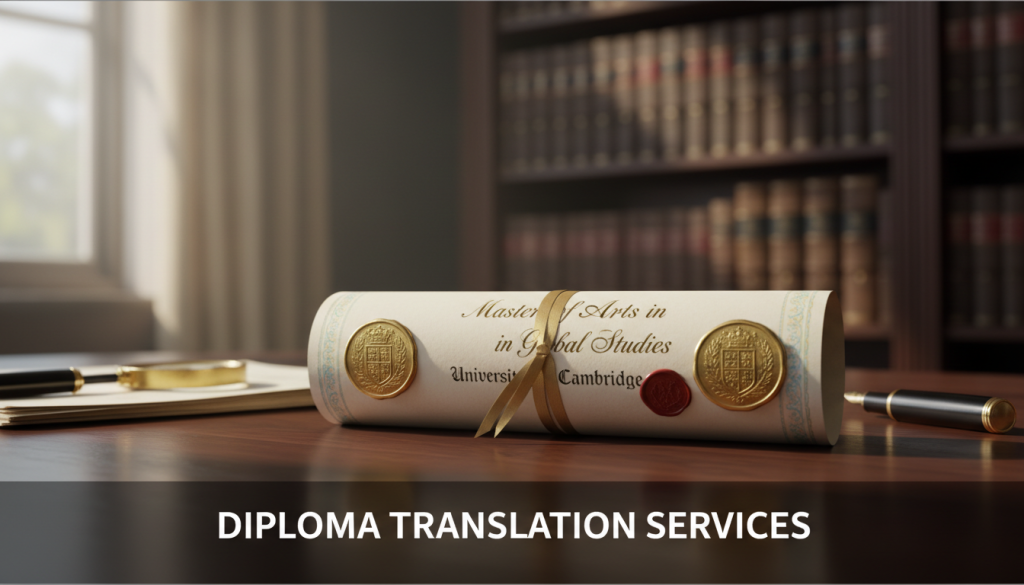
Diploma Translation Requirements: Award Titles, Seals and Institution Names
A diploma looks simple until it has to be used in another country, another language, or another admissions system. What appears to be a short certificate often carries a surprising amount of meaning in its award title, institution name, seals, signatures, serial numbers, and formatting. If any of those elements are mishandled, a translation that looks polished can still create questions, delays, or outright rejection.
That is why diploma translation requirements are not just about converting words. A good translation must preserve what the document says, how it identifies the awarding institution, and which official marks appear on the page. It must also show where the translator is translating visible text and where they are adding a note to explain a seal, stamp, signature, or partially legible mark.
Whether you are submitting a diploma for university admission, employment screening, immigration, professional registration, or a qualification comparison, the safest approach is to treat the diploma as an official record, not a marketing certificate. The goal is clarity, completeness, and traceability.
If you need a professionally prepared academic translation for an urgent submission, start your project with a clear scan and request a certified review before the deadline gets too close.
What Most Diploma Translations Need to Include
In practical terms, a complete diploma translation usually needs to cover:
- the full award title exactly as shown on the document
- the name of the institution as issued
- the graduate’s name as it appears on the source document
- the date of award or conferral date
- any classification, honours, distinction, or final mention
- visible seals, stamps, embossed marks, and signatures
- document numbers, folio numbers, or registration references where present
- translator notes for text that is visible but not suitable to translate as normal running text
- a certification statement when the receiving body requires a certified translation
A diploma can be only one page, but that one page may carry information in the margins, in a round seal, inside a coat of arms, or in a handwritten signature line. Leaving those out can create avoidable problems.
Why Diploma Translations Get Delayed
Most problems do not come from basic vocabulary. They come from judgment errors.
1. The Award Title is Over-Interpreted
A translator sees an academic title and converts it into the nearest English equivalent without preserving the original nuance. That can be risky. Some titles should be translated directly. Others should be retained in the original and clarified in brackets or a translator note.
2. The Institution Name is “Normalized”
The diploma may show one exact institutional name, while the translation substitutes a shortened brand name, a modern rebrand, or an informal English version. This creates a mismatch between the translation and the source.
3. Seals and Stamps are Omitted
A seal may contain the institution’s name, faculty name, ministry reference, or a confirmation that the award is official. If it is visible on the original, it usually needs to be accounted for.
4. Signature Areas are Treated Inconsistently
Official documents often contain signatures, initials, handwritten dates, or partly legible names. These should not be guessed. They should be noted carefully and honestly.
5. The Diploma is Translated Without the Supporting Academic Record
Sometimes the diploma alone is not enough. The receiving body may also need the transcript, diploma supplement, mark sheet, or course list to understand the qualification properly.
The Safest Rule for Award Titles
Award titles are one of the most sensitive parts of diploma translation requirements because they are often highly specific to a country or academic system.
A safe method is:
- preserve the original meaning, not just the nearest English-sounding label
- avoid “upgrading” or “downgrading” the award
- keep distinctions, honours, and classifications visible
- use a translator note where a direct one-word equivalent would mislead
For example, a title that literally translates as “Specialist Diploma” may not function exactly like “Bachelor’s degree” in another country. A title such as Licenciatura, Maîtrise, Diplom-Ingenieur, or Laurea Magistrale should be handled with care, especially when the receiving institution will assess comparability separately.
A Practical Way to Present It
A strong diploma translation may use one of these patterns:
- Direct translation only when the meaning is straightforward and widely understood
- Original title + English rendering when precision matters
- Original title + translator note when the award belongs to a system with no exact one-line equivalent
Example:
Award Title: Licenciatura en Administración de Empresas
Translation: Bachelor-level qualification in Business Administration
Translator note: Original award title retained in source language where institutional equivalence may be assessed separately.
That approach is often safer than forcing a title into a familiar but inaccurate category.
Institution Names Must Match the Document First
When people think about diploma translation requirements, they often focus on the qualification title. In reality, institution names cause just as many issues.
The golden rule is simple: the translation should match the awarding institution as shown on the diploma.
That means checking:
- the exact institution name on the document
- whether the diploma uses a faculty, department, or university-wide name
- whether the institution has an official English version
- whether the document shows an older historical name
- whether the seal uses a slightly different form of the same name
When the Institution Has an Official English Name
If the university officially uses an English version of its name, that may be used carefully, provided it stays faithful to the source. Consistency matters more than stylistic polish.
When the Institution Does Not Have an Official English Name
In that case, transliteration or a literal rendering may be needed. The safest option is often to preserve the source-language form and explain it rather than invent a polished English brand name.
When the Diploma and Seal Differ Slightly
This is common. The main body may show the full university name, while the seal shows an abbreviated faculty form. Both can be reflected separately, for example:
Institution: National University of …
Seal note: Round seal reading “Faculty of Engineering, National University of …”
That keeps the translation clear without pretending the two pieces of text are identical.
How to Handle Seals, Stamps, and Embossed Marks
This is where many weak diploma translations fall apart.
A seal is not decorative. It is evidence. If it contains readable text, it should be represented. If it is visible but unreadable, that should be stated honestly.
Good Practice for Visible Official Marks
Use brief, neutral notes such as:
- [Round seal: Ministry of Education, Republic of …]
- [Embossed seal present]
- [Blue ink stamp: Office of the Registrar]
- [Signature]
- [Illegible signature]
- [Handwritten registration number: 2021/4876]
These notes work because they separate translated document content from descriptive notation.
What Not to Do
Do not:
- ignore seals because they are hard to read
- invent text that cannot be confirmed
- merge stamp text into the main body without showing it came from a stamp
- describe logos in unnecessary detail unless they contain text relevant to the document
If the Mark is Partly Legible
Be transparent. For example:
[Round seal, partially legible: “… University … Faculty of Medicine”]
That is far better than guessing.
Signature Notes Should Be Useful, Not Dramatic
Signatures on diplomas are usually there to show authorization, not to provide narrative detail. A translation should record their presence clearly and briefly.
Useful options include:
- [Signed]
- [Signature of Rector]
- [Illegible signature]
- [Two signatures present]
Where the printed title appears beneath the signature, translate the printed title and note the signature separately.
Rector
[Signature]
That structure is easy for admissions officers, employers, and caseworkers to follow.
When a Diploma is Not Enough on Its Own
Many clients ask for diploma translation requirements when they actually need a package, not a single page.
In many real-world submissions, the diploma works best alongside:
- an academic transcript
- a diploma supplement
- mark sheets
- a statement of grading scale
- a certified copy of a name-change document if names differ
- passport identification if name spelling needs to be checked for consistency
If the diploma shows only the award title and date, the transcript is often the document that explains modules, grades, credits, and medium of instruction. Translating one without the other can leave gaps.
That is especially important when deadlines are close. A fast quote is helpful, but a complete document set is usually what prevents follow-up requests later.
A Simple Test: Can a Stranger Verify the Document from the Translation?
One of the easiest ways to judge a diploma translation is to ask this:
If someone had never seen this education system before, could they still understand what was awarded, by whom, when, and under what visible official markings?
If the answer is no, the translation needs work.
A strong translation helps the reader verify:
- who issued the diploma
- what qualification was awarded
- when it was awarded
- which official marks are visible
- which parts are main text and which parts are translator notes
- whether any wording is uncertain or partly legible
That is what turns a translated diploma into a usable submission document.
Common Mistakes That Create Avoidable Risk
Rewriting the Diploma into “Natural English”
Official documents should not read like brochures. Clean English matters, but fidelity matters more.
Dropping Repeated Institutional Wording
A seal, header, and footer may repeat the same institution name. If those are visible on the source, they may still need to be shown in some form.
Changing Academic Distinctions
“Honours,” “distinction,” “merit,” “excellent,” and system-specific classifications are not interchangeable.
Treating Abbreviations Casually
Abbreviations can refer to ministries, faculties, state bodies, or regional education authorities. Expand only when justified.
Ignoring Bilingual Originals
If the diploma already includes two languages, the translation still needs to reflect what appears on the source document and avoid mixing source and translation logic.
A Safer Workflow for Diploma Translations
The strongest diploma translations usually follow a simple process.
Step 1: Start with a High-Quality Scan
A blurred phone photo creates uncertainty around seals, serial numbers, accents, and small print. A flat, well-lit scan saves time and reduces guesswork.
Step 2: Say Where the Translation Will Be Used
University admission, immigration, employer screening, and qualification comparison do not always ask for the same supporting documents.
Step 3: Confirm the Name Format
If the diploma spelling differs from the passport or current legal name, flag that early. It is much easier to address upfront than after a submission is questioned.
Step 4: Include the Transcript if Relevant
If the receiving body needs evidence of subjects, credits, grades, or award structure, the diploma alone may not be enough.
Step 5: Request Certification Where Needed
When a receiving body wants a certified translation, the translation should be delivered with the appropriate certification statement, date, signature, and translator or agency details. If your deadline is close, upload the diploma and any transcript pages together so the translation can be prepared as one coherent academic package.
What a Strong Diploma Translation Looks Like in Practice
Here is the difference between a weak approach and a strong one.
Weak Approach
- translates only the large body text
- omits seal wording
- changes the institution name into a convenient English brand
- turns a system-specific award title into a generic degree label
- gives no note for an illegible signature
Strong Approach
- translates all relevant visible text
- notes seals, stamps, embossed marks, and signatures
- keeps the institution name faithful to the source
- handles award titles cautiously and transparently
- distinguishes main text from translator notes
- includes certification when official submission requires it
That difference is often what separates a smooth submission from a request for clarification.
Why This Matters for Admissions, Employers, and Official Reviewers
A diploma translation is often read by someone outside the source country’s academic system. They may not know whether a title is undergraduate or postgraduate, whether a seal belongs to a ministry or a faculty, or whether a handwritten note changes the meaning of the document.
The translation should not force them to guess.
A well-prepared diploma translation reduces friction because it gives the reviewer:
- a clear record of the award title
- a faithful rendering of the institution name
- a visible note of seals and signatures
- a transparent explanation of uncertain text
- a professional format that mirrors the source logically
That is why careful academic translation is not just a language service. It is document-risk control.
Need Your Diploma Translated Without the Guesswork?
Next Day Translation supports academic document submissions where details like institution names, award wording, signatures, and seals need to be handled carefully from the start. If your diploma is part of an urgent application, send the scan together with any transcript pages and state the purpose of use clearly. That gives the translator the context needed to prepare a cleaner, safer submission pack.
For urgent academic deadlines, the best move is to upload your file early, confirm where it will be submitted, and request a certified version if official use is involved.
Final Checklist Before You Submit a Diploma Translation
Use this quick review before sending your documents to a university, employer, evaluator, or official body:
- the award title matches the source document accurately
- the institution name is consistent across the body text and visible seals
- the graduate’s name is checked carefully against the source
- dates, serial numbers, and registration references are included
- seals, stamps, signatures, and embossed marks are represented
- partly legible text is marked honestly
- transcript pages are included if the receiving body needs subject or grade detail
- the certification statement is included where required
- the final layout is clear enough for a reviewer to follow quickly
A diploma may be short, but the translation still needs to do a lot of work. The more faithfully it reflects titles, institution names, and official marks, the easier it is for your document to be accepted without follow-up.
FAQs
What are the main diploma translation requirements?
The main diploma translation requirements are accuracy, completeness, faithful handling of award titles and institution names, and clear notation of seals, stamps, signatures, and document numbers. If the document is for official use, a certified translation may also be required.
Do seals and stamps need to be translated on a diploma?
Yes, where seals and stamps contain visible text or clearly show official validation, they should usually be represented in the translation through concise translator notes such as bracketed descriptions.
Should institution names be translated or left in the original language?
That depends on the document and the institution. If an official English name exists and matches the source context, it may be used carefully. Otherwise, the safer option is often to preserve the original form or use a precise transliteration with a clear note.
Can I translate only my diploma without my transcript?
Sometimes yes, but many receiving bodies need both. If they must assess modules, grades, credits, or the structure of the qualification, a transcript or diploma supplement may also be necessary.
How should signatures appear in a diploma translation?
Signatures should be noted clearly and honestly, for example as “[Signature]” or “[Illegible signature].” Printed roles such as Rector, Dean, or Registrar should be translated where visible.
What causes diploma translations to be rejected or questioned?
Common issues include incomplete translations, omitted seals, inconsistent institution names, over-interpreted award titles, guessed handwriting, and missing certification where official submission requires it.