
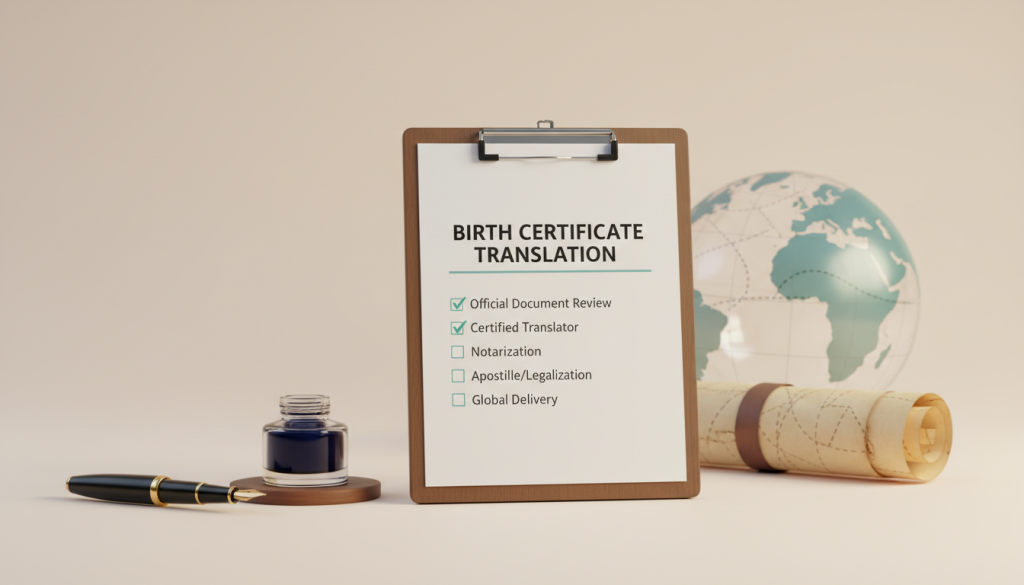
The quick checklist
Before you submit your birth certificate translation, make sure all of the following are true:
- The entire certificate has been translated, not just the main fields.
- Names match the source document exactly, with a clear approach to name order and transliteration.
- Place names are handled consistently and not casually “modernised.”
- Parent details, including maiden names, are included where shown.
- Marginal notes, side notes, handwritten amendments, and later annotations are translated.
- Stamps, seals, signatures, and embossed marks are translated or clearly described.
- Dates, registration numbers, and reference codes are carried over accurately.
- Blank, crossed-out, or illegible sections are marked clearly rather than guessed.
- The translation is accompanied by a certification statement, signature, date, and contact details.
- You are submitting the right underlying document type, especially if the authority wants a full certificate rather than a short version.
A birth certificate translation can read fluently and still fail if it is incomplete. For official use, completeness matters as much as language accuracy.
What UK authorities expect from a certified birth certificate translation
For UK use, the safest standard is a full certified translation prepared by a professional translator or translation company. In practice, that means the translation should mirror the original document closely and be accompanied by a formal certification page.
A proper submission pack usually includes:
- A clear copy of the original birth certificate
- The full English translation
- A certification statement
- The translator’s or agency’s identifying details
- The date of translation
- Signature details where required for the receiving authority
This is where many applicants lose time. They focus on the translation itself, but the rejection risk is often in the packaging around it. A clean, complete translation with weak certification can still cause unnecessary follow-up.
If you are working to a strict deadline, upload your file first and confirm the submission standard before ordering. That is especially important if your document will be used for immigration, passport evidence, court work, or overseas legalisation.
The details that most often cause rejection
Name order is changed without explanation
Birth certificates from different countries present names differently. Some place the family name first, while others place multiple surnames together. Some include patronymics, middle names, or religious names in a way that does not align neatly with a UK passport or BRP.
The mistake is not that the names look unfamiliar. The mistake is changing them casually. A professional translation should reflect the original certificate faithfully. If there is a genuine identity-matching issue, it should be handled carefully and consistently, sometimes with a short translator’s note rather than a silent rewrite.
For example, if the certificate presents the name in one order but the passport shows the same elements in another order, the translation should not invent a cleaner UK-style version and hope for the best. It should preserve the certificate and help the reviewer understand it.
Place names are translated too loosely
Place of birth fields cause more trouble than people expect. Some translators translate a place name into its familiar English equivalent, while others transliterate it or leave it in the original form. The real problem begins when the approach changes within the same document pack.
A place name on the birth certificate should be handled in a way that is accurate, consistent, and defensible. If the receiving authority is checking the birth certificate against a passport, previous application, or supporting record, inconsistency can trigger avoidable questions.
The safest rule is this: do not normalise place names casually. If the certificate gives a specific town, district, or province in a particular form, the translation should stay close to that wording and remain consistent across the pack.
Marginal notes are ignored
This is one of the most common hidden problems. Many birth certificates contain side notes, later entries, rectifications, adoption references, legitimisation notes, marriage-related annotations, or registrar comments added after the original registration. These notes are not decoration; they can change the legal meaning of the record.
If the certificate has a note in the margin, along the bottom, on the reverse, or in handwritten form, it should be translated. A translation that covers only the central typed text but misses the annotation is incomplete. In official document review, incomplete often means unusable.
Stamp translation is missing
Stamps and seals matter because they tell the reviewer what authority issued, registered, reviewed, or certified the document. That means stamp translation is not optional on a birth certificate intended for formal use. Even when the stamp text is partly unclear, its presence should still be acknowledged and described as precisely as possible.
Examples include:
- Civil registry stamps
- Registrar office seals
- Municipal authority stamps
- Consular stamps
- Receipt or archive marks
- Round seals, box stamps, and embossed seals
A strong translation either translates the text in the stamp or describes the visible mark clearly, such as “round registry stamp,” “embossed seal,” or “illegible official stamp,” where necessary.
Dates and numbers are reformatted badly
Birth certificates are identity documents. Dates, certificate numbers, register references, act numbers, and issue dates need to remain exact. A good translator does not “improve” the data; they preserve it. That also means avoiding ambiguous date formats. Writing the month in words is often the clearest approach in English because it removes confusion between day-month-year and month-day-year formats.
The wrong certificate is being translated
Sometimes the translation is fine, but the source document is the real issue. In the UK, some processes require a full birth certificate rather than a short version. If the authority needs parent details and the document supplied only shows the child’s details, the translation cannot solve that problem.
This matters particularly in passport and nationality-related scenarios, where the certificate version itself can affect acceptability.
What must be translated on a birth certificate
A complete birth certificate translation should usually cover all visible content, including:
- Child’s full name
- Date of birth
- Time of birth, where shown
- Place of birth
- Sex, where shown
- Parents’ names
- Mother’s maiden name, where shown
- Parents’ places of birth, nationality, occupation, or marital details, where shown
- Registration district, registry office, municipality, province, or state details
- Certificate number, act number, book number, folio, page, and reference numbers
- Issue date and issue location
- Signatures
- Stamps and seals
- Handwritten additions
- Marginal notes
- Corrections, cancellations, or amendments
- Visible blanks, deletions, or crossed-out entries where they affect meaning
This is the core principle many shorter guides miss: official translations are not summaries. A birth certificate translation is not there to explain the document in general terms. It is there to reproduce the document in English as faithfully and clearly as possible.
Full certificate or short certificate?
Not every authority asks the same question, but many UK processes are focused on the full birth certificate because it contains more identifying information. A short certificate may not show the parent details, and that can become a problem where the application depends on parentage, nationality history, or fuller identity evidence.
So before you order the translation, ask two questions:
- Does the receiving authority want a birth certificate, or a full birth certificate?
- Does the receiving authority also want linked documents, such as a marriage certificate, passport, or name-change document?
This is one of the easiest ways to prevent rejection before it happens.
Certified, notarised, or apostilled?
These terms are often mixed together, but they are not the same thing.
Certified translation
This is the starting point for most UK submissions. It is the standard option for many immigration, academic, legal, and administrative uses.
Notarised translation
This is only needed when the receiving authority specifically asks for notarisation. It adds an extra formal step and is not automatically required just because the document is important.
Apostille or legalisation
This usually becomes relevant when the document or translation will be used outside the UK, or when a foreign authority asks for legalisation. If that is your route, check the exact requirement before ordering, because the process can depend on whether the original document, the translation, or both need further formalisation.
If you are unsure, do not guess. Send the instruction from the authority with your file and get the correct route confirmed before you pay.
How to prepare your birth certificate before ordering translation
A faster translation starts with a cleaner file. Use this document prep checklist:
1. Scan the whole document
Capture full edges, corners, seals, and margins. Do not crop tightly around the central text.
2. Check both sides
Some certificates carry notes, stamps, or legal annotations on the reverse.
3. Avoid blur and glare
If you are taking a phone photo, place the certificate on a flat surface in bright, even light.
4. Keep colours natural
Do not over-edit the image. Heavy contrast can hide embossed marks or faint notes.
5. Send related documents where relevant
If the birth certificate links to a passport, marriage certificate, or name-change record, mention that at the start. It helps the translator spot identity consistency issues earlier.
A clear scan does not just help the translator. It also helps the final reviewer, because the formatting, notes, and official marks can be mirrored more accurately in the English version.
What a professional birth certificate translation should include
When you order from a professional service, the finished translation should not feel improvised. It should look structured, deliberate, and ready to submit. You should expect:
- A full English translation of the certificate
- Careful handling of name order and place names
- Translation of marginal notes and stamp text
- Consistent rendering of dates and reference numbers
- A certification statement
- Translator or agency contact details
- Date of issue of the translation
- Signature details appropriate to the service level
- A PDF that is easy to attach to an online application or send to a solicitor, university, or caseworker
At Next Day Translation, clients typically use this service for visa packs, passport evidence, civil status files, and urgent official submissions where accuracy and turnaround both matter. Clear scans are enough to start, so there is no need to delay while waiting to post originals just to obtain a quote.
A practical identity check before submission
Before you upload or print anything, compare the translated birth certificate against the rest of your document pack. Check these items line by line:
- Does the translated full name match the identity document strategy used elsewhere in the application?
- Does the place of birth match the spelling used in your other official records, or is any difference clearly understandable?
- Are parent names, including maiden names, fully present?
- Are any annotations or later changes reflected?
- Are all registry marks, seals, and stamps accounted for?
- Are dates unambiguous?
- Does the certification page contain all required details?
- Are you attaching the right version of the certificate?
This five-minute review catches a surprising number of avoidable issues.
Birth certificate translation checklist you can copy before submission
Use this as your final pre-submission checklist:
- I am using the correct certificate type for the authority.
- The scan is complete, clear, and shows all edges.
- The translation covers every visible field.
- All names are accurate and consistent.
- Name order has not been changed carelessly.
- Parent details and maiden names are included where shown.
- Place names are translated or transliterated consistently.
- Marginal notes and handwritten entries are included.
- Stamp translation has been handled properly.
- Seals, signatures, and embossed marks are translated or described.
- Dates and reference numbers match the original.
- Illegible text is marked honestly, not guessed.
- The certification statement is included.
- The translation is dated.
- Translator or agency contact details are present.
- I have checked whether notarisation or apostille is actually required.
- The final PDF is ready to upload or print.
If you want a second pair of eyes before you submit, upload your file and get the translation checked against the real authority requirement rather than relying on guesswork.
Why clients choose Next Day Translation for birth certificate work
Birth certificate translations look simple until they are not. They often contain older registry language, unusual name structures, faint stamps, handwritten notes, and country-specific formatting that needs careful handling. That is exactly why people use a specialist service instead of treating the certificate like ordinary text.
Next Day Translation supports official document submissions across the UK and handles certified translations for personal, legal, academic, immigration, and administrative use. If your deadline is close, same-day and next-day options may be available depending on the document and language pair.
If you are ready to move, send your certificate now and get a clear quote, turnaround time, and confirmation of the best submission format for your case.
Frequently Asked Questions
Can I translate my own birth certificate for use in the UK?
It is a bad idea for any formal submission. UK authorities usually expect an independent professional translation that can be verified. A self-translation creates avoidable questions about independence, accuracy, and acceptability.
Do stamps, seals, and marginal notes need translating?
Yes. On a birth certificate, stamps, seals, and marginal notes can carry legal or administrative meaning. Leaving them out can make the translation incomplete.
What if my birth certificate name order is different from my passport?
That is exactly the kind of issue a professional translator should handle carefully. The birth certificate should be translated faithfully, while the overall document pack should remain consistent. Silent rewriting is risky; accurate translation with clear handling is safer.
Do I need a full birth certificate or a short one?
That depends on the receiving authority. Many official processes prefer or require a full birth certificate because it includes parent details. Always check this before ordering the translation.
Do I need notarisation or apostille as well as a certified translation?
Not always. For many UK submissions, certified translation is enough. Notarisation or apostille should usually only be added when the receiving authority specifically asks for it.
How quickly can a birth certificate translation be done?
Turnaround depends on the language pair, the clarity of the scan, and whether the certificate includes handwritten notes, marginal entries, or extra formalities. If the deadline is urgent, send the document early and state the submission date clearly.
Final word
The best birth certificate translation checklist is not complicated. It is disciplined. Translate everything. Keep identity details consistent. Do not ignore marginal notes. Do not skip stamp translation. Do not assume the short certificate will do the job of a full one. And do not leave certification details until the end.
That is how you reduce the chance of delay, follow-up, or rejection.
For a fast, professionally prepared birth certificate translation, upload your file to Next Day Translation and get a clear quote with the right certification route from the start.