Why Machine Translation Is Not Accepted for Official Submissions
If you searched for why machine translation is not accepted, the clearest answer is this: official bodies do not accept a translation just because it reads well. They accept it because it is complete, verifiable, properly presented, and backed by a named professional who takes responsibility for it. UK guidance for visa-related submissions requires a full translation that can be independently verified, including confirmation of accuracy, the date, the translator’s name and signature, and contact details. For some passport processes, the translation must also be signed and stamped by a translator who is a member of a recognised professional organisation.
That is why a machine-translated document can look fine and still fail. The wording may seem understandable, but official submissions are not judged on “close enough.” They are judged on whether the translation can be trusted, checked, and attached to a formal decision. Readable is not the same as acceptable. For official use, a translation must do more than convert words; it must stand up to scrutiny.
For many applicants, the surprise is not that software can make mistakes. The real surprise is that even a mostly accurate machine output still lacks the one thing official submissions need most: accountable human certification.
The Real Reason Machine Translation Fails Official Submissions
There are four tests most official translations need to pass:
1. It Must Be Independently Verifiable
A caseworker, university admissions team, court clerk, passport examiner, solicitor, or compliance officer needs to know who produced the translation and how to verify it. A machine output usually gives them none of that:
- No named translator.
- No signature.
- No contact details.
- No professional responsibility.
- No reliable route to query a disputed phrase.
That matters because UK immigration guidance does not just ask for a translation; it asks for one that can be independently verified. If a translation is missing or cannot be verified, the document may be treated as though it was not provided at all.
2. It Must Be Complete, Not Merely Understandable
Official submissions are not about gist. They are about full meaning, including:
- Headings
- Reference numbers
- Seals and stamps
- Handwritten notes
- Side notes
- Dates
- Names
- Issue authorities
- Annotations
- Footnotes
- Amendments
- Crossed-out text
A machine tool may translate the main body in a readable way while mishandling the small details that actually matter most. In official paperwork, those details often carry legal or evidential weight.
3. It Must Be Formatted for Review
A reviewer needs to compare the source with the translation quickly and confidently. That means the final translation should clearly show that it is a translation, reflect the original structure where appropriate, and present visual elements properly. Certified translations should be clear, readable, and consistent with the original as far as practical, while also making clear that the document is a translation.
4. It Must Be Backed by Accountability
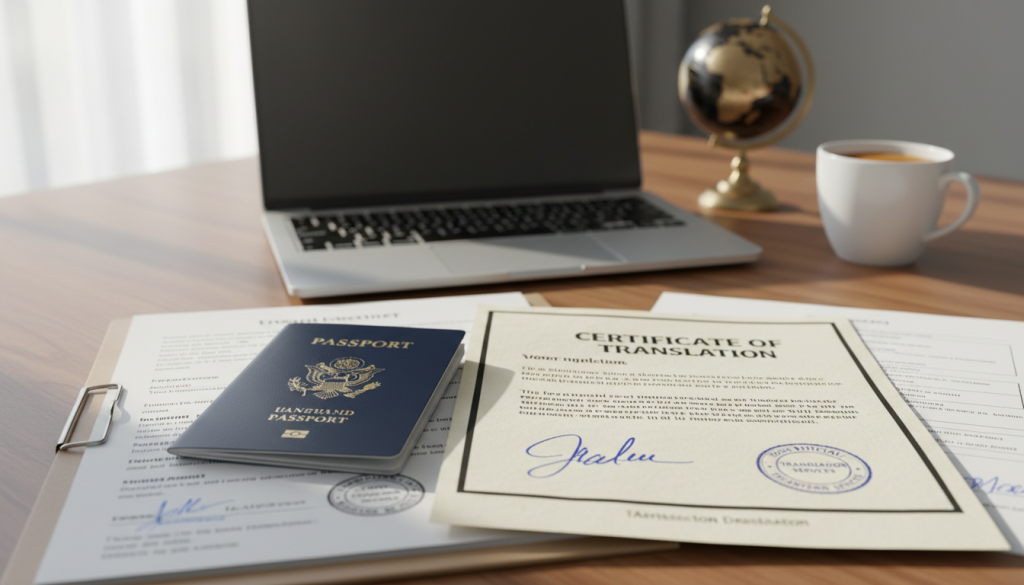
The certificate is not decoration; it is the point. Professional guidance describes the translation certificate as an essential part of a certified translation because it proves that the translation is accurate and faithful to the original. That certificate is expected to include a statement of accuracy, the date, the translator or company details, and a signature. Machine translation cannot sign that statement, accept liability, explain its decision-making, or defend the wording if questioned. The absence of a certificate can make a document unsuitable for official submission.
Why “It Looks Fine to Me” Is a Risky Standard
A lot of rejected translation problems are invisible to non-specialists. A document may look polished and still contain issues such as:
- A surname rendered inconsistently across two pages.
- A date format switched from day/month/year to month/day/year.
- A stamp left untranslated.
- A handwritten correction omitted.
- An official title translated into a similar but incorrect term.
- A note in the margin ignored because the software treated it as image noise.
- A table rearranged so the link between columns becomes unclear.
- An ambiguous word translated the common way instead of the legally correct way.
None of those errors necessarily jumps out at first glance, but each can create doubt, delay, or rejection. Southwark Council’s disclaimer for its machine-based website translation states that the output is not carried out by a professional translator, may not take account of context, and is not guaranteed for accuracy or sense. This highlights the risks of relying on machine output for high-stakes paperwork.
Machine Translation vs Certified Human Translation
| Issue | Machine Translation | Certified Human Translation |
|---|---|---|
| Accuracy Statement | Not provided | Included |
| Named Responsibility | No | Yes |
| Signature and Date | No | Yes |
| Contact Details | No | Yes |
| Verifiability | Weak or absent | Clear |
| Stamps, Seals, Handwritten Notes | Often mishandled or omitted | Deliberately identified and translated |
| Formatting for Review | Inconsistent | Prepared for official reading |
| Acceptance for Official Submissions | Risky | Designed for acceptance |
The Hidden Failure Points in Official Documents
Names and Identity Details
Official submissions often live or die on exact identity matching. A single inconsistency between the source document, passport, visa form, bank statement, or supporting letter can cause confusion. Machine translation is especially risky where names appear in multiple grammatical forms, scripts, or official naming conventions.
Dates, Places, and Document Numbers
Reference numbers, issue dates, expiry dates, municipality names, registry office names, and certificate numbers are core identifiers. If these are presented unclearly, the reviewer may question whether the translation matches the original.
Stamps, Seals, and Annotations
A translated birth certificate, court document, police certificate, tax letter, or academic transcript often includes elements outside the main paragraph text, such as:
- Embossed seals
- Rectangular stamps
- Handwritten approvals
- Registrar notes
- Seal text around a circle
- “Duplicate” or “certified copy” markings
- Amendments or strike-throughs
Professional guidance specifically addresses how these should be represented in translation, highlighting their importance.
Official Terminology
Some phrases are ordinary in daily language but highly specific in formal documents. Examples include terms for civil status, legal capacity, custody, final decree, permanent residence, police clearance, transcript classification, notarisation, apostille, and registry extract. A machine may choose the statistically common meaning, but official reviewers need the procedurally correct one.
Where Machine Translation Is Most Likely to Cause Trouble
Immigration and Visa Submissions
This is the biggest danger zone. Visa and immigration packs often contain multiple documents from different authorities, each with names, dates, numbers, stamps, and supporting evidence that must line up. UK guidance is explicit about full, certified, independently verifiable translations.
Passport Applications
Passport-related guidance can be stricter on proof of genuineness. For some paper and overseas passport routes, the translation must be signed and stamped by a translator who belongs to a recognised professional organisation.
Court and Solicitor Bundles
A court or legal reviewer needs precision, consistency, and document integrity. Small translation shortcuts are not minor when they affect evidence, chronology, or legal meaning.
Academic and Professional Recognition
Transcripts, diplomas, grade scales, module titles, and award classifications must be translated carefully and consistently. A polished-looking output that mishandles grading language or award status can create unnecessary back-and-forth.
Banking, Compliance, and Source-of-Funds Evidence
Bank statements, payslips, tax notices, shareholder records, and company documents are often checked line by line. Loose translation of labels, balances, tax terms, or authority names can weaken the submission.
What a Proper Certified Translation Usually Includes
A professionally prepared certified translation is typically built around three things:
The Translation Itself
This should be full, careful, and clearly laid out.
The Certificate
This confirms that the translation is true and accurate and includes the translator or company details, date, and signature. UK professional guidance treats this certificate as essential.
Presentation That Supports Acceptance
This means sensible structure, clarity, and treatment of non-standard elements such as stamps, handwritten notes, seals, and formatting cues from the original.
The Fastest Safe Route Is Not the Cheapest Shortcut
People often turn to machine translation because they are in a rush. That is understandable. Deadlines for visas, court hearings, university enrolment, compliance checks, and employment onboarding are real. However, for official paperwork, the fastest safe route is usually professional review first, not software first.
A rushed machine version often creates a second job: submit, get queried or rejected, scramble for a proper certified translation, and lose time you thought you were saving. That is why a strong process matters more than a quick-looking output.
A Practical Rule: Use Machine Translation for Understanding, Not for Submitting
There is a place for machine translation. It can help you:
- Understand the rough meaning of a document.
- Identify which pages matter most.
- Flag urgent terminology for discussion.
- Prepare questions before ordering a professional translation.
- Sort a large file set before deciding what needs certified translation.
However, it should not be your final submission document where the authority expects certification, verifiability, formatting discipline, or formal accountability.
A Better Way to Think About Acceptance
When an official body reviews a translated document, they are effectively asking:
- Can we trust this?
- Can we identify who stands behind it?
- Can we verify it if something is unclear?
- Does it appear complete?
- Does it preserve the evidence on the page?
A machine-translated document usually fails that test before anyone even debates the wording. That is the heart of the issue behind machine translation not being accepted.
What to Do Instead If You Have an Official Deadline
1. Send the Clearest File You Have
Use a flat scan or high-quality PDF where possible. Include every page, even blank backs if they contain stamps, marks, or reference codes.
2. Say Where the Translation Will Be Used
A translation for a visa application, passport file, university, court, employer, or bank review may need different presentation choices.
3. Ask for Certification from the Start
Do not order a basic translation and hope it will be enough later.
4. Mention Every Supporting Page
If there is a stamp page, reverse side, handwritten amendment, annex, or notes page, include it.
5. Confirm Delivery Format
Some organisations accept digital PDFs. Others may require a signed hard copy, especially in more formal legal contexts. Professional guidance recommends checking the authority’s preference in advance where format matters.
Why Clients Choose Next Day Translation for Official Documents
Next Day Translation positions its service around professional human translation, same-day and next-day turnaround options, and certified translations prepared for official, legal, academic, immigration, and business use. The site also highlights support for documents used with UKVI, the Home Office, HMCTS, HM Passport Office, DVLA, FCDO, and UK universities. This matters when the job is not just “translate this,” but “help me submit this properly.”
If Your Document Is for Official Use, the Safer Question Is Not:
“Can software translate it?”
It Is:
“Will the final document be accepted without problems?”
That is where professional preparation makes the difference.
A Simple Final Test Before You Submit
Before you upload or post any translated document, check these five points:
- Does it include a signed certification statement?
- Is the translator or translation company clearly identified?
- Are contact details shown?
- Have stamps, notes, seals, and handwritten parts been dealt with properly?
- Does the layout make it easy for a reviewer to compare with the original?
If the answer to any of those is no, the document may be readable but still not submission-ready.
Need It Done Properly, Not Just Quickly?
If your document is going to an official body, the safest move is to start with the final requirement in mind. Send the document, state the purpose, and get it prepared as a certified translation from the outset. This avoids the common trap of using a machine draft first and paying for the delay later.
For urgent immigration, legal, academic, and official paperwork, Next Day Translation’s live pages currently emphasise human translation, certification support, and fast turnaround routes for time-sensitive submissions.
FAQs
Is Machine Translation Accepted for UK Visa Applications?
Usually, that is the wrong approach for a UK visa submission. UK guidance expects a full translation that can be independently verified and includes an accuracy statement, date, translator name, signature, and contact details. A plain machine output does not meet that standard.
Can I Use Google Translate for a Birth Certificate or Marriage Certificate?
For informal understanding, it may help you read the document. For official submission, it is a poor choice because it does not provide certification, accountability, or the full formal presentation expected for official paperwork.
What If the Machine Translation Is Actually Accurate?
Even then, accuracy alone is not enough. Official acceptance depends on more than wording; it also depends on certification, verifiability, formatting, and named responsibility.
Is Machine Translation Plus Proofreading Enough?
Not automatically. A corrected machine draft only becomes suitable for official use if a qualified professional fully takes responsibility for the final text and provides the proper certification and presentation required for the receiving authority.
What Must a Certified Translation Include in the UK?
Common requirements include confirmation that the translation is accurate, the date, the translator’s or company representative’s name and signature, and contact details. Some authorities may have extra expectations around stamps, professional affiliation, or delivery format.
Are Digital Certified Translations Accepted?
Often yes, but not always. Some authorities accept PDFs for online submissions, while certain legal or formal uses may still require physically signed hard copies. It is worth checking the destination authority’s format requirements before ordering.