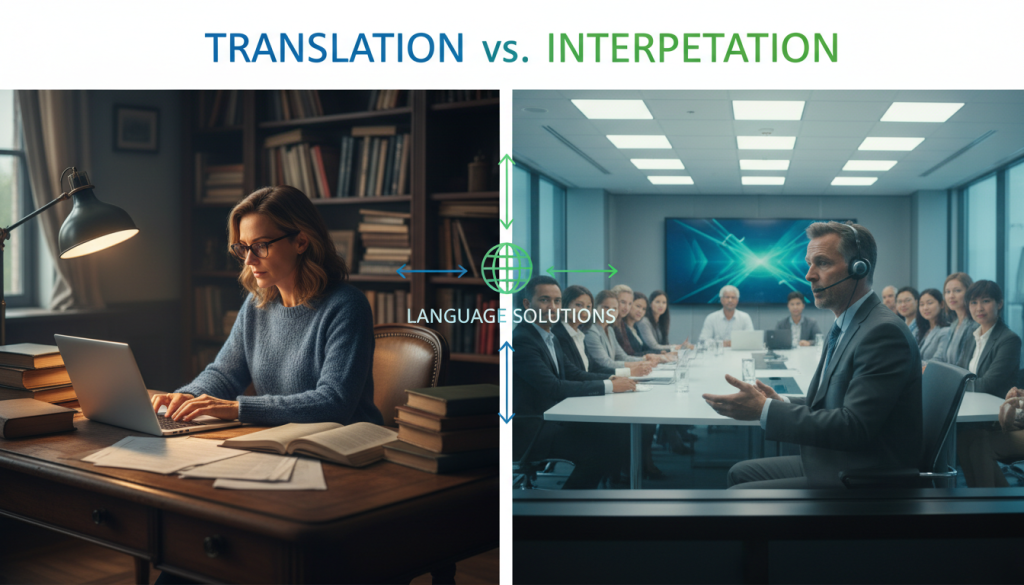
The fastest way to understand the difference
Here is the simplest rule:
- You have a birth certificate, contract, transcript, passport, bank statement, or court document — you need a translator.
- You have a live appointment, interview, consultation, hearing, meeting, or call — you need an interpreter.
- You have foreign-language documents plus a live meeting about them — you need both.
That is the core translator vs interpreter difference: written vs spoken.
What does a translator do?
A translator converts written text from one language into another. The job is not just changing words; a good translator preserves meaning, tone, terminology, and context while ensuring the final text reads clearly and naturally in the target language.
A translator may work on:
- Birth certificates
- Marriage certificates
- Passports
- Academic transcripts
- Legal contracts
- Bank statements
- Company documents
- Medical reports
- Supporting evidence for immigration or court matters
For official use, you may also need a certified translation, which includes the required certification wording and professional details for submission to the relevant authority.
When translation is the right service
You need translation when the original content exists on paper, in a PDF, in an image, or in a digital file, and the end result must also be a written document. Common examples include:
- Translating a birth certificate for a visa application
- Translating a degree certificate for university admission
- Translating a contract for legal review
- Translating company paperwork for overseas use
- Translating medical documents for treatment or claims
If your goal is to hand over a finished document that someone can read, review, file, or submit, you need a translator.
What does an interpreter do?
An interpreter converts spoken language in real time. Instead of producing a written document, the interpreter facilitates understanding during a live conversation. This may occur:
- In person
- Over the phone
- By video call
- During a conference
- During a legal or medical appointment
- During an interview or meeting
The interpreter listens, understands, and delivers the message in another language as accurately and clearly as possible. This requires fast processing, excellent listening skills, strong short-term memory, and the ability to keep pace with the conversation.
When interpreting is the right service
You need interpreting when the issue is not a document but a conversation. Common examples include:
- A solicitor meeting with a non-English-speaking client
- A GP or hospital appointment
- A school meeting with parents
- A business negotiation with overseas partners
- A court or tribunal hearing
- A Home Office interview
- A police interview
- A video call with an international supplier
If people need to understand each other in real time, you need an interpreter.
Written vs spoken: why the confusion happens
The confusion arises because both professions operate across languages, making them seem interchangeable to those outside the industry. However, they solve different problems:
- A translator provides a document you can keep, review, edit, and submit.
- An interpreter offers live communication support while people are speaking.
This difference affects how the work is delivered, how accuracy is checked, how the service is priced, what tools are used, what training is most relevant, and what results you receive.
Translator vs interpreter difference at a glance
1. Medium
Translator: written language
Interpreter: spoken language
2. Output
Translator: a written file or formatted document
Interpreter: live oral communication
3. Timing
Translator: usually completed over hours or days
Interpreter: delivered immediately, in real time
4. Revision
Translator: can research, review, edit, and proofread
Interpreter: must process and deliver instantly
5. Typical setting
Translator: office, remote workflow, document handling
Interpreter: meeting room, courtroom, clinic, phone, video call, conference
6. Common use cases
Translator: certificates, contracts, statements, reports, transcripts
Interpreter: interviews, consultations, hearings, meetings, calls
The different types of interpreting
Not all interpreting is the same, and understanding the distinctions is crucial when booking support.
Consecutive interpreting
The speaker pauses after a sentence or short section, allowing the interpreter to deliver the message in the other language. This is common for:
- Solicitor appointments
- Medical consultations
- Interviews
- Community and public-service settings
- Smaller meetings
Simultaneous interpreting
The interpreter delivers the message almost simultaneously with the speaker, typically using specialized equipment or a live audio setup. This is common for:
- Conferences
- Formal events
- Large multilingual meetings
- Live broadcasts
Liaison interpreting
The interpreter assists two or more people in communicating back and forth in a smaller setting. This is common for:
- Business meetings
- School meetings
- Site visits
- Private appointments
Telephone interpreting
The conversation occurs by phone, with the interpreter joining remotely. This is useful when:
- The matter is urgent
- No local interpreter is available
- Travel is unnecessary
- The conversation is short and practical
Video interpreting
The interpreter joins through a video platform, often a strong option when visual cues matter but in-person attendance is impractical.
Sight translation
This sits between the two disciplines, where a linguist reads a written document and provides an oral rendering on the spot. It can be useful in hearings, interviews, or appointments where immediate understanding of a document is necessary.
The different types of translation
Translation encompasses a wide range of work. Choosing the right service depends on the document’s purpose.
Certified document translation
Used for official submissions such as:
- Visa applications
- Passport matters
- Court paperwork
- Academic enrollment
- Employer checks
- Civil records
Legal translation
Used for:
- Contracts
- Witness statements
- Affidavits
- Court documents
- Powers of attorney
- Compliance materials
Academic translation
Used for:
- Diplomas
- Transcripts
- Degree certificates
- Reference letters
- Research documents
Business translation
Used for:
- Company documents
- Reports
- Presentations
- Policies
- Commercial correspondence
Document support vs meeting support
This is often the easiest way to choose correctly.
You need document support if:
- You must submit paperwork
- You need a PDF or printed translation
- An organization needs to read a foreign-language document
- The end result must be stored, emailed, uploaded, or filed
You need meeting support if:
- You are attending an appointment
- Two sides need to speak live
- Questions and answers will happen in real time
- The goal is understanding during a conversation
You may need both if:
- You have a foreign-language document and a related hearing
- You have to submit evidence and attend an interview
- You need contracts translated before a live negotiation
- You want a written translation plus an interpreter for the meeting itself
A simple 3-question test before you book
If you are unsure which service to request, use this test.
1. Is the source written or spoken?
If it is written, start with translation. If it is spoken, start with interpreting.
2. What is the final result you need?
If you need a document you can send or submit, choose translation. If you need two people to understand each other live, choose interpreting.
3. Will somebody need to review the final wording later?
If yes, translation is usually required. If the priority is live understanding in the moment, interpreting is usually required.
Real-world examples
Example 1: Visa application
You have a marriage certificate and bank statements in another language. You need: a translator. Why: the documents must be translated into written English for submission.
Example 2: GP appointment
A patient speaks limited English and needs help explaining symptoms. You need: an interpreter. Why: this is a live spoken interaction.
Example 3: Court matter
You must submit foreign-language evidence and also attend a hearing. You need: both. Why: the documents need written translation, and the hearing may require spoken interpreting.
Example 4: Business expansion
You want a supplier agreement translated and then need help during a negotiation call. You need: both. Why: the contract needs written translation and the meeting needs interpreting support.
Example 5: University admission
You are submitting transcripts and degree certificates. You need: a translator. Why: these are written academic records, often requiring certified translation.
Can one person do both jobs?
Sometimes, yes. Some linguists are qualified and experienced in both translation and interpreting. However, you should not assume that every translator is also the right interpreter for a live assignment, or that every interpreter is the right person for official written documents. The disciplines overlap in language knowledge, but the delivery method is different. Written accuracy, document formatting, terminology research, note-taking, listening stamina, live delivery, and managing pressure all place different demands on the linguist. That is why choosing by task is better than choosing by title.
What happens if you choose the wrong service?
This is where mistakes can become costly. If you book an interpreter when you really need translation:
- You still will not have a written document to submit.
- Deadlines may be missed.
- The authority may reject incomplete paperwork.
If you book a translator when you really need an interpreter:
- The live conversation still cannot happen properly.
- Misunderstandings may continue.
- The meeting may need to be rescheduled.
A quick check at the start usually prevents all of this.
What official submissions usually need
For most official UK submissions involving foreign-language paperwork, the need is for translation, not interpreting. This is especially true for:
- Civil certificates
- Identity documents
- Immigration evidence
- Legal papers
- Academic records
- Financial paperwork
Where certification is required, the translation must be prepared in the right format with the right professional details. If you are working to a deadline, it makes sense to get that confirmed before ordering. If your documents are ready, send them over, and we will confirm the correct service, turnaround, and whether certification is needed.
How to choose correctly when time is short
When clients are in a rush, the best approach is not to guess. It is to describe the situation clearly. Send:
- The document or file, if there is one
- The purpose of the job
- The deadline
- The language pair
- Whether the need is written, spoken, or both
- Whether the job is for an official body, meeting, or hearing
This allows the project team to recommend the right service quickly and avoid delays.
“I needed a certified birth certificate translation for my visa application and had less than 24 hours. Next Day Translation delivered perfectly formatted documents within hours.” – Aleksandra M.
“Used them for urgent legal documents ahead of a court deadline. The turnaround was incredibly fast, the translation was thorough and well-presented.” – James B.
The practical takeaway
If it is a document, think translator. If it is a conversation, think interpreter. If your case involves both paperwork and a live meeting, you may need both. That is the clearest answer to the translator vs interpreter difference.
When in doubt, do not order blindly. Send the files, explain the setting, and let the service be matched to the job. That is the fastest way to get the right support and avoid paying twice.
FAQs
What is the main translator vs interpreter difference?
The main difference is that a translator works with written text, while an interpreter works with spoken language in real time.
Do I need a translator or interpreter for official documents?
For official documents such as birth certificates, marriage certificates, passports, contracts, and transcripts, you usually need a translator, not an interpreter.
Do I need an interpreter for a meeting or appointment?
Yes. If the support is for a live conversation, such as a legal appointment, medical consultation, interview, or business meeting, you usually need an interpreter.
Can the same project need both translation and interpreting?
Yes. A case may require written document translation for submission and spoken interpreting for a hearing, interview, or meeting about those documents.
Is sight translation the same as written translation?
No. Sight translation is an oral rendering of a written text on the spot. It can be useful in live settings, but it does not replace a professionally prepared written translation for formal submission.
How do I choose correctly if I am not sure?
Look at the end result you need. If you need a written document to submit, choose translation. If you need live spoken communication support, choose interpreting. If you have both, ask for a combined solution.