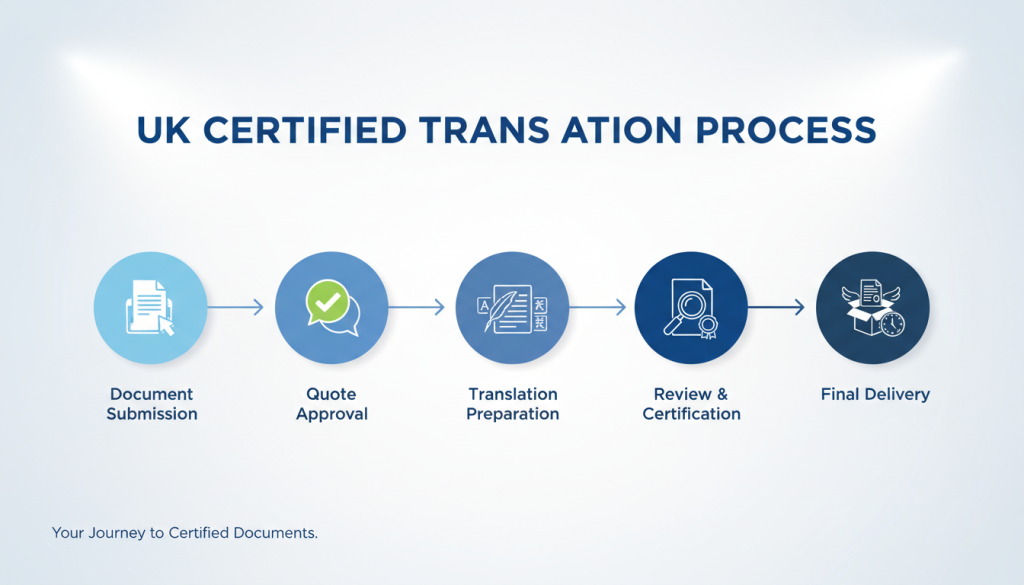
What the certified translation process usually looks like
A well-run certified translation order moves through five simple stages:
- You send the document
- You receive and approve the quote
- The translation is prepared
- The translation is reviewed and certified
- The finished files are delivered by PDF, post, or both
That sounds straightforward because it is. Problems usually appear only when one of three things slows the order down:
- The scan is incomplete or hard to read
- Key details such as names, dates, or reference numbers need confirming
- The client waits too long to approve the quote
In other words, the biggest time-saving step is often not “faster translation.” It is better preparation at the start.
A simple next-day timeline
Here is a realistic example of how a next-day certified translation can move from quote to delivery when the file is clear and the document type is routine.
Morning: upload and review
08:30 – Documents sent
You upload clear scans, photos, or PDFs and mention the deadline, target language, and whether you need PDF only or a printed hard copy as well.
09:00 – Quote issued
The team reviews the file, checks legibility, identifies the document type, confirms whether certification is required, and sends a fixed quote with the turnaround.
Late morning: approval and assignment
09:15 – Quote approved
Once the quote is approved, the order can move forward immediately.
09:30 – Translator assigned
A suitable translator is assigned based on the language pair, document type, and urgency.
Midday to afternoon: translation and review
11:30 – First pass completed
The document is translated with attention to names, dates, stamps, seals, numbers, and formatting.
13:00 – Review and quality check
The text is checked for accuracy, consistency, completeness, and presentation.
14:30 – Certification prepared
The certification statement and supporting details are added so the translation is ready for official use.
Afternoon to next day: delivery
16:00 – Digital delivery
The certified translation is delivered by PDF for fast submission.
If requested – hard copy arranged
Where a physical copy is needed, printing and post can be arranged alongside the digital version.
Not every job follows those exact hours. Larger bundles, less common language pairs, handwritten sections, or multiple supporting documents can change the pace. But the structure remains the same.
Step 1: Sending your documents the right way
The upload stage is where speed is either protected or lost.
A translation team can only quote and schedule properly when the document is readable and complete. That means every page matters, including reverse sides if they contain stamps, annotations, or issue details.
What to send
For the fastest intake, send:
- Clear full-page scans or well-lit photos
- Every page in the correct order
- The original-language document, not cropped screenshots
- Any spelling-sensitive details you want matched carefully
- The deadline and where the document will be used
- Whether you need digital delivery, posted hard copy, or both
What often causes delays
Common intake problems include:
- Blurred phone photos
- Missing pages
- Cut-off edges
- Glare over stamps or signatures
- Low contrast black-and-white scans
- Multiple unrelated documents mixed into one unnamed file
A good rule is simple: if a stamp, date, or handwritten note is hard for you to read, it is likely to slow the translation team too.
If time matters, upload your file with the clearest version you have and mention any sections you are unsure about. That helps queries get resolved before they become a delay.
Step 2: Quote approval and what the price usually reflects
Once the document has been reviewed, the next step is the quote.
A proper quote is not just a number. It confirms what is being translated, the required service level, and how the finished documents will be delivered.
What is usually assessed in the quote
The quote stage normally considers:
- Document type
- Number of pages or word count
- Language pair
- Turnaround requirement
- Whether certification is needed
- Whether digital PDF is enough or a hard copy is also required
Why approval speed matters so much
Many people assume the translator is the bottleneck. In urgent work, that is often not true. The real delay is often the time between receiving the quote and confirming the order.
If you are working to a visa, court, university, or employer deadline, approve as soon as you are satisfied with the turnaround and delivery method. That is often the difference between same-day movement and avoidable overnight drift.
Step 3: Translation and review
This is the stage clients see least, but it is where the real value sits.
Certified translation is not just changing words from one language into another. Official documents need careful handling because small details carry practical importance. A wrong number, inconsistent spelling, or missed stamp can create unnecessary questions later.
What the translator is checking as they work
A professional certified translation process usually pays close attention to:
- Personal names
- Dates of birth and issue dates
- Places of issue
- Certificate numbers
- Stamps, seals, and marginal notes
- Signatures where visible
- Headings and document structure
- Official terminology
- Numerical formatting
This is especially important on civil certificates, legal records, academic transcripts, and immigration evidence packs, where a single mismatch can create confusion.
What review should cover before delivery
Before delivery, the translation should be checked for:
- Completeness
- Consistency of names and dates
- Accurate rendering of visible official marks
- Clear formatting
- Certification details
- Overall readiness for submission
This is also where a strong service protects the client from preventable issues. A fast translation is helpful. A fast translation that still needs correcting is not.
Step 4: Certification and final preparation
Once the translation has been checked, it must be prepared in a format suitable for official use.
For most UK purposes, that means the translation is accompanied by a certification statement confirming that it is a true and accurate translation of the original, together with the professional details needed for submission.
What clients usually receive
A properly prepared certified translation package commonly includes:
- The translated document
- A certification statement
- Date of issue
- Signature
- Translator or agency details
- Professional formatting suitable for submission
This stage matters because many clients understandably focus on the translated text alone. In reality, official acceptance often depends just as much on how the translation is presented and certified.
When extra steps may be needed
Sometimes a certified translation is enough on its own. Sometimes the receiving authority asks for more, such as solicitor certification, notarisation, or apostille/legalisation.
That is why one of the smartest things a client can do is mention exactly where the document is going. A translation for UKVI, a university, a court, or an overseas authority may not all require the same handling.
Step 5: Delivery by email, post, or both
Delivery is the final step, but it should be discussed before the job begins, not after it is finished.
PDF delivery
For many UK submissions, PDF delivery is the fastest and most practical option. It is especially useful when:
- The authority accepts digital uploads
- You need to attach the translation to an online application
- Speed matters more than physical presentation
- You want a same-day or next-day route with minimal friction
Posted hard copy
A posted copy can still be useful when:
- The receiving body prefers printed documents
- Your solicitor, employer, or institution wants a paper pack
- You want a physical copy for your own records
- The destination body has stricter submission preferences
The safest option when you are unsure
If the authority has not clearly said whether PDF is enough, asking for both digital and hard copy is often the safest route. That way you can meet immediate deadlines without losing the option of physical submission.
If your deadline is close, request your quote with the delivery method stated clearly from the start. That keeps the final step predictable.
What makes next-day delivery realistic
A next-day certified translation is most realistic when the order has four things in place:
- A clear, complete document
- A routine document type
- Prompt quote approval
- A straightforward delivery requirement
A single birth certificate, marriage certificate, police certificate, passport page, or academic certificate can often move quickly when those conditions are met. A larger pack with bank statements, supporting letters, handwritten notes, and multiple attachments naturally takes more care.
That is why sensible timing matters. Next-day service is strongest when the workflow is simple and the file is ready.
A practical checklist before you request your quote
Before sending your file, check these points:
- Is every page included?
- Are all stamps, seals, and edges visible?
- Have you said where the translation will be used?
- Have you asked for certified translation if it is for official use?
- Have you stated whether you need PDF, post, or both?
- Have you mentioned the real deadline?
That sixty-second check can save far more than sixty minutes later.
Real proof that the process matters
Clients usually remember speed first, but the strongest feedback often combines three things: speed, clarity, and acceptance.
One visa client needed a certified birth certificate translation in less than a day and received a properly formatted file in time for submission. A university admissions client needed translated degree documents urgently and got them accepted without delay. Another client facing a legal deadline praised the fast turnaround and the careful presentation of the final paperwork.
Those examples all point to the same truth: a smooth process is not just convenient. It reduces stress when the document actually matters.
Common documents that follow this timeline
The same core process applies across many document types, including:
- Birth certificates
- Marriage certificates
- Divorce certificates
- Passports
- Police certificates
- Degree certificates
- Academic transcripts
- Legal agreements
- Immigration supporting documents
- Business records
If you have a mixed pack, it is still worth sending everything together. Bundled review can make the quote clearer and the delivery plan more efficient.
Why a simple process is better for clients
The best certified translation process UK clients can follow is not the most complicated one. It is the clearest one.
You should know:
- What to send
- When you will get the quote
- What happens after approval
- How the translation is checked
- What will be delivered
- When it will arrive
That clarity matters because most clients are not ordering a translation for casual reasons. They are applying, submitting, enrolling, marrying, relocating, proving identity, or meeting a legal requirement. A confusing process adds pressure at exactly the wrong time.
When the process is clear, the client can focus on the deadline rather than chasing updates.
Final thought
From the outside, certified translation can seem like a black box. You send a document and hope the right thing comes back. It should not feel like that.
A strong service turns the process into something simple: upload, quote, approve, translate, review, deliver.
That is the timeline most people need. And when the scans are clear, the instructions are specific, and the quote is approved quickly, next-day delivery becomes far more achievable.
If your documents are ready, upload your file and request your quote now. It is the fastest way to move from uncertainty to a finished translation you can actually use.
Frequently Asked Questions
How long does the certified translation process usually take in the UK?
For a short, clear document, the certified translation process can move from upload to delivery within a day or by the next working day. Timing depends on the language pair, document type, page count, and how quickly the quote is approved.
Do I need to send original documents for a certified translation?
In many cases, no. A clear scan, photo, or PDF is enough to start the quote and translation process. What matters most is that the copy is complete, readable, and shows all relevant details.
What is included in a certified translation for UK use?
A certified translation for UK use usually includes the translated document plus a certification statement, date, signature, and translator or agency details so the translation is ready for official submission.
What can delay a next-day certified translation?
The most common delays are blurred scans, missing pages, unclear stamps, unconfirmed spellings, late quote approval, and changes to delivery requirements after the translation has already started.
Is PDF delivery enough for a certified translation?
Often, yes. Many UK submissions can be made using a digital PDF. However, some organisations or overseas authorities may prefer or require a printed hard copy, so it is always wise to check before ordering.
Do I need notarisation or apostille as well as a certified translation?
Sometimes. A standard certified translation is often enough for UK submissions, but overseas authorities or certain legal uses may require notarisation or apostille/legalisation too. The safest approach is to confirm the destination requirement before the order begins.